

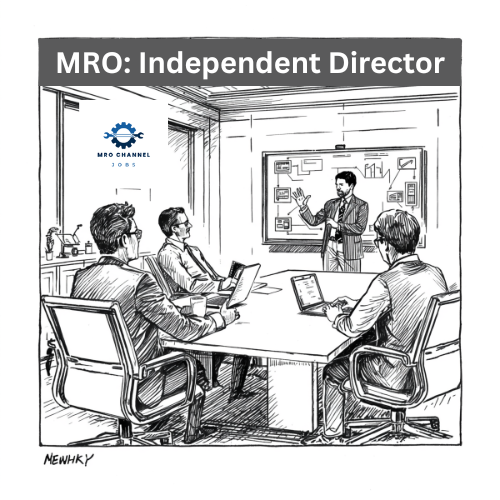
India’s rapidly expanding industrial landscape—covering logistics, aviation, manufacturing, railways, defence, and infrastructure—depends fundamentally on the reliability and efficiency of physical assets. Yet, despite this dependence, Maintenance, Repair, and Overhaul (MRO) expertise remains underrepresented in corporate boardrooms. As companies increasingly seek to optimize costs, enhance resilience, and extend asset life, appointing experienced MRO professionals as Independent Directors offers a powerful, yet largely untapped, strategic advantage.
At the core of this value lies a deep understanding of asset lifecycle management. MRO professionals bring decades of hands-on experience in managing assets from acquisition and commissioning to maintenance, overhaul, and eventual retirement. This enables boards to move beyond short-term financial thinking and adopt a lifecycle cost optimization approach, ensuring that decisions are both economically and operationally sound over the long term.
Equally important is their ability to drive cost optimization through preventive insight. Unlike traditional cost-cutting measures that often compromise reliability, MRO experts understand where savings can be achieved without increasing risk. Their focus on preventive and predictive maintenance strategies helps reduce unplanned downtime, avoid costly breakdowns, and improve overall operational efficiency—directly impacting profitability.
MRO professionals also play a critical role in strengthening operational governance. As Independent Directors, they bring a practical, ground-level perspective that complements financial and strategic oversight. They are well-positioned to question maintenance practices, evaluate vendor contracts, and identify inefficiencies in spare parts management. This leads to greater transparency, accountability, and discipline in asset management processes.
In industries where safety and reliability are paramount, their contribution to risk mitigation and safety enhancement cannot be overstated. Poor maintenance can lead to serious incidents, regulatory penalties, and reputational damage. With their experience, MRO professionals can identify latent risks, ensure adherence to safety standards, and foster a culture of reliability and compliance across the organization.
Another area where they add significant value is in vendor and supply chain optimization. Maintenance-related expenditures are often influenced by complex vendor ecosystems. MRO experts can assess vendor performance beyond pricing, improve contract structures, and rationalize inventory levels. This results in reduced waste, improved supplier accountability, and better cost control.
In today’s data-driven environment, MRO professionals also contribute to enhanced decision-making through operational metrics. Their familiarity with reliability indicators and maintenance analytics ensures that board discussions are informed by meaningful data. This helps align strategic goals with operational realities and supports more accurate performance monitoring and forecasting.
Perhaps one of their most important contributions is bridging the gap between boardroom strategy and shop-floor execution. Many strategic decisions fail due to a disconnect from ground realities. MRO professionals bring practical insights that challenge assumptions, validate feasibility, and ensure that strategies are implementable, realistic, and sustainable.
Their role also aligns closely with ESG and sustainability objectives. Efficient maintenance practices extend asset life, reduce resource consumption, and minimize environmental impact. By integrating these principles into corporate strategy, MRO professionals help organizations move toward more sustainable and responsible operations.
India is uniquely positioned to benefit from this approach, given its large pool of highly experienced, retiring MRO professionals from defence services, public sector units, and large industries. Appointing them as Independent Directors not only preserves valuable knowledge but also enriches board diversity with technical depth and operational wisdom.
In conclusion, incorporating MRO expertise at the board level is not merely an operational enhancement—it is a strategic imperative. Companies that recognize and leverage this capability will be better equipped to achieve cost efficiency, operational excellence, and long-term sustainability in an increasingly competitive environment.