
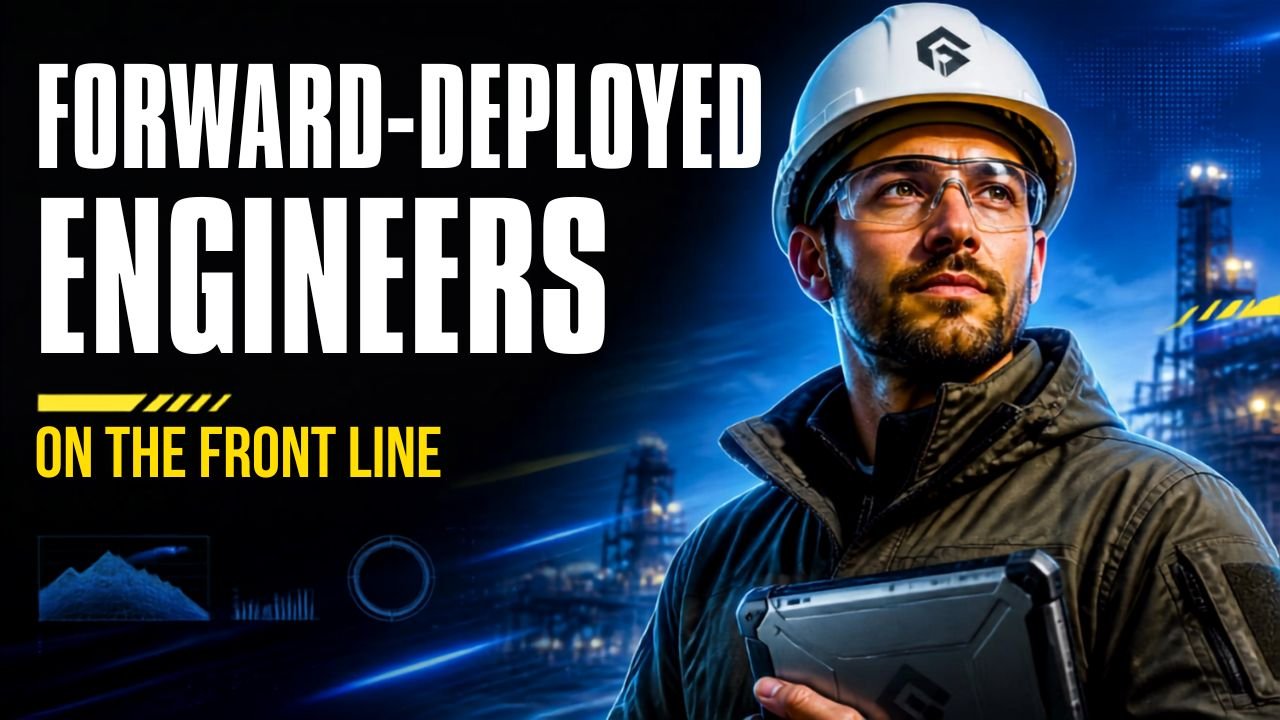
Artificial intelligence is changing the software industry at an incredible speed. One of the newest job titles attracting attention is the Forward Deployed Engineer. The role is becoming common in AI companies because these engineers work closely with customers, understand their problems, and quickly turn AI capabilities into practical business solutions.
Many people see this as a completely new way of delivering software. But there is another side to the story that deserves equal attention.
The discussion is often centred on AI companies working directly with customers. However, thousands of traditional software companies already have deep relationships with their clients. These companies understand their customers’ businesses, have years of domain knowledge, and have experience delivering customised software. AI may not replace these companies. Instead, it may make them more capable than ever before.
In the past, developing software was a slow process. Engineers gathered requirements, discussed them with customers, designed the system, wrote code, tested it, fixed bugs, and repeated the cycle many times. Every customer request could lead to several rounds of changes before the final product was ready.
Today, AI has changed much of this process.
Once engineers understand the customer’s problem, AI tools can help generate code, suggest designs, automate testing, identify errors, and improve documentation. Human engineers still guide the process, review the results, and make the important technical decisions, but much of the routine work can now be completed far more quickly.
This means that traditional software companies can deliver working solutions in a fraction of the time they once needed.
The biggest benefit is not only speed. It is also quality.
AI-assisted development allows teams to test software earlier, detect many common errors automatically, and improve reliability before the software reaches the customer. Although human review remains essential, customers are increasingly receiving better-tested solutions with shorter delivery times.
The result is higher customer satisfaction.
When customers request changes, companies can respond much faster than before. Instead of waiting through long development cycles, many improvements can be designed, built, tested, and delivered in a much shorter time. This creates a more responsive relationship between the software provider and the customer.
This is where the idea of the Forward Deployed Engineer becomes especially interesting for traditional software businesses.
Instead of being limited to AI companies, this role can become an important part of every software organisation. These engineers can work directly with customers, understand business problems in real time, and use AI-powered development tools to create solutions quickly. They become the bridge between customer needs and rapid software delivery.
Their value lies not simply in knowing AI tools, but in combining customer understanding, technical knowledge, business awareness, and AI-assisted development into one role. Companies that already have strong customer relationships may find this to be a natural extension of the services they already provide.
As AI continues to improve, many people wonder whether software engineering jobs will disappear.
History suggests otherwise.
Every major technological change has transformed jobs rather than eliminated them completely. Programming languages, cloud computing, mobile applications, and low-code platforms all changed how software was built. Yet software engineers continued to play an essential role by adapting to new tools and new ways of working.
Artificial intelligence appears to be following the same pattern.
The work of software engineers is changing, but the need to understand customer problems, make sound technical decisions, ensure quality, and deliver business value remains as important as ever. AI accelerates development, but people still provide the judgement, creativity, and responsibility needed to build successful software.
The rise of Forward Deployed Engineers may therefore represent not the replacement of traditional software companies, but their evolution. Organisations that combine trusted customer relationships with AI-assisted development and rapid delivery may become stronger competitors in the years ahead.
Rather than asking whether AI will replace software companies, a more useful question may be this: Which companies will learn to combine human expertise with AI most effectively? Those organisations are likely to define the next chapter of software development.